

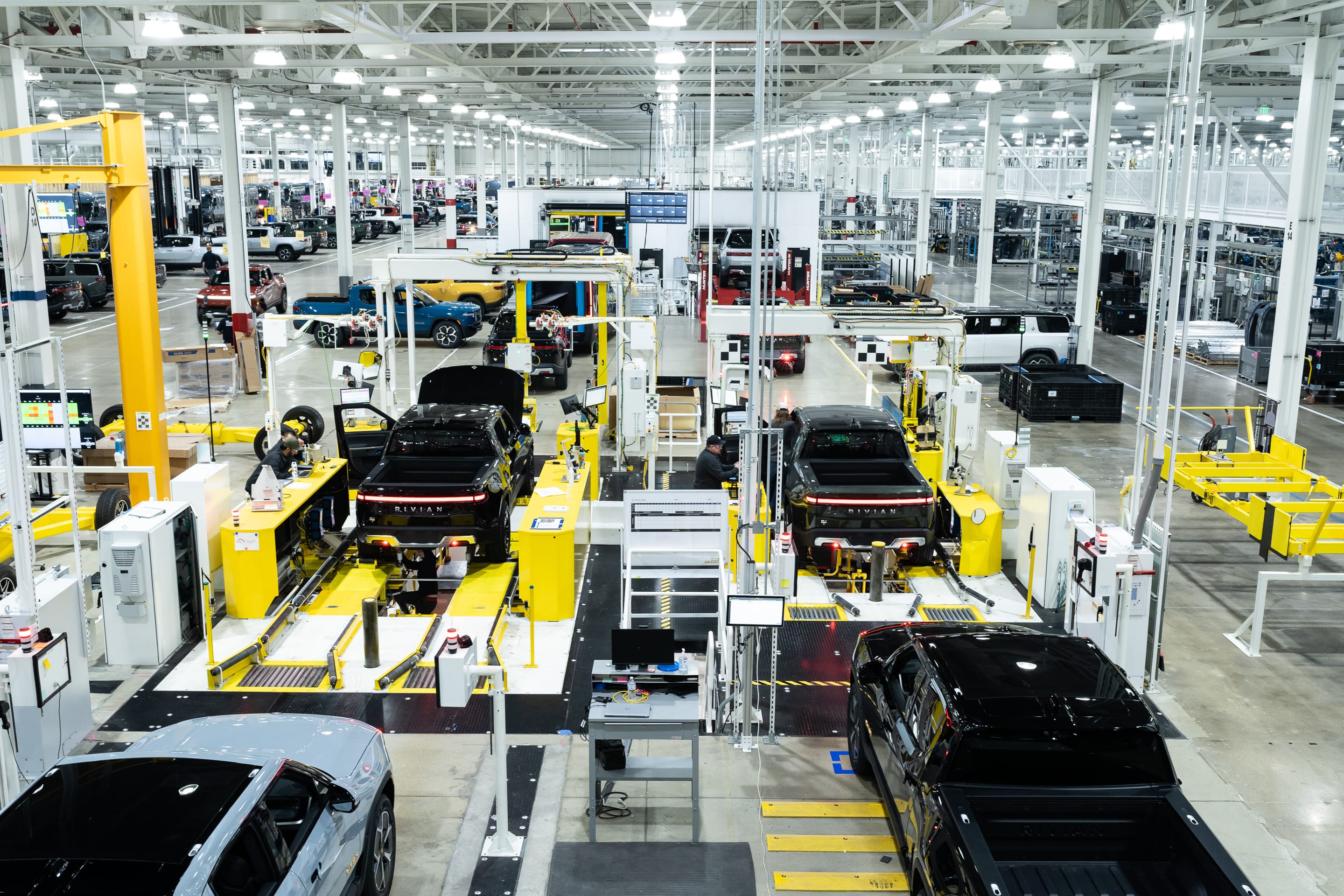
Editor's note: The analysis and context below are my own. For full details on Scaringe's comments, see the original Bloomberg Technology interview, and for Rivian's financial disclosures, see the Q4 2025 earnings call transcript.
When Bloomberg's Ed Ludlow asked RJ Scaringe this week about reports that Rivian is in talks to license its autonomy stack to other automakers, Scaringe did something interesting. He did not confirm any specific deal. He also did not deflect. He reframed the question into a sentence I keep coming back to: there are two revenue opportunities in what Rivian is building, and vehicle sales is only one of them.
That second revenue line is what almost no one covered from the interview. It is worth sitting with.
What the Volkswagen Deal Actually Is
The headline number is easy to repeat and easy to misread. According to Volkswagen Group's announcement of the joint venture launch, VW committed up to $5.8 billion to Rivian, not for vehicles, not for a factory, and not for a stake in Rivian itself. For software. Specifically, for Rivian's electrical architecture, its operating system, and the compute platform that runs underneath its in-vehicle experience. The joint venture that runs all of this is called Rivian and VW Group Technologies, often shortened to RV Tech. It has been operating as an independent company since November 13, 2024.
The structure is worth understanding, because it tells you what VW actually believes. One billion dollars came in as an initial convertible note. About $1.3 billion came at closing in exchange for a 50 percent equity stake and background IP licenses. The remainder comes in tranches tied to technical milestones, which Rivian has indicated it is meeting.
On Rivian's Q4 2025 earnings call in February, CFO Claire McDonough disclosed that Rivian received another $1 billion payment from VW Group in July 2025 after hitting a milestone, and is expected to receive an additional $2 billion in capital as part of the joint venture in 2026. According to TechCrunch's coverage, the total disbursed to Rivian is roughly $4 billion by the end of March, with another billion scheduled to unlock in October 2026, and a final $500 million tranche pegged to joint vehicle production starting in 2027.
This is not a handshake deal with optionality. VW is paying, on a schedule, against technical milestones. The joint software platform finished winter testing in Arizona and Sweden earlier this year. That is what unlocked the most recent tranche.

The scale of what this stack is expected to run on is where the number starts to feel real. Volkswagen has publicly said RV Tech's platform will eventually underpin up to 30 million vehicles across its portfolio, including Volkswagen, Audi, and Scout. Scout's Traveler SUV and Terra pickup are slated to launch on the platform starting in 2027. Audi is building a vehicle on it for 2028. At SXSW in March 2026, as reported by EV Magazine, Scaringe characterized the Volkswagen arrangement as the largest software licensing deal in the history of the automotive industry.
Why This Looks Different From an Automaker
Every OEM talks about becoming a tech company. Almost none of them mean it, because the business model of making vehicles and the business model of licensing technology are not the same business. One has single-digit margins, physical inputs, and capital intensity measured in billions. The other has margins that can exceed 30 percent in automotive and scales without more factories. According to Rivian's Q4 2025 earnings disclosures, the contrast is plain: the software and services segment posted $179 million in gross profit on $447 million in revenue. The automotive segment, over the same quarter, posted a $59 million gross loss. For the full year, software and services delivered $576 million in gross profit. Automotive lost $432 million at the gross level.
Scaringe understands this distinction. In the Bloomberg interview, he described the two revenue lines using plain language: one is selling more R2s, which is the vehicle business, and the other is leveraging the technology Rivian is developing. He specifically called out the OS, the compute stack, and eventually the autonomy platform as the things that can be licensed. Vehicle licensing is not what he is describing. Technology licensing is.
His software chief, Wassym Bensaid, who also co-runs RV Tech, has been more direct when talking to reporters outside of earnings calls. At the joint venture's first anniversary media event in November 2025, as reported by EV Magazine citing InsideEVs, Bensaid described the ambition as a reference operating system for the automotive industry, roughly analogous to what Android became in mobile. He also said out loud what most executives will not: licensing software is a very different business with a very different margin profile than building cars. He knows. That is the point.
The Skeptics Have a Case
UBS analyst Joseph Spak published a note on April 21 that sums up the honest counterargument: a shared platform makes strategic sense, but legacy automakers are unlikely to hand their technology stack to a direct competitor in the near term, and Rivian has not yet signed a second customer for the autonomy software specifically. Without that second customer, the scale and data flywheel that would make autonomy genuinely differentiated does not yet exist. Fair points, all of them. Worth holding in mind.
Why I Still Think the Licensing Line Matters
Two reasons.
First, the VW deal is producing revenue now, not someday. According to Rivian's Q4 2025 earnings call, about 60 percent of the software and services segment's Q4 revenue, $273 million out of $447 million, came from the VW joint venture. Full-year software and services revenue hit $1.56 billion, up 222 percent year over year, and made up 29 percent of total company revenue, compared to 10 percent in 2024. This is a line item that did not meaningfully exist three years ago. Most automakers trying to build a software business are still in the slide deck stage. Rivian is past that.
The customer concentration is a real risk. One major licensee is not a business, it is a contract. I would not paper over that.
Second, the structural case has very little to do with whether another automaker signs next month. The point of having a compute stack, an OS, and an autonomy platform that are already shipping in production vehicles is that you can show them working. Legacy automakers have spent years trying to build software-defined vehicles and, in many cases, have struggled publicly. VW's own software arm, Cariad, has faced well-documented challenges, and bringing in Rivian was part of the response. If one major automaker reached that conclusion, I would expect others to weigh the same calculation over time.
The question is not whether Rivian's technology is attractive. It clearly is, because Volkswagen Group paid $5.8 billion for access to it. The question is whether Rivian can support a licensing business alongside a vehicle business without doing damage to either. That is a real operational question, and it is the one I would be watching for over the next four quarters.
What to Watch For
If you want to track whether this second revenue line is becoming real, the signals are not buried in earnings releases. They are in the news cycle.
A second major licensing partner, or even a memorandum of understanding that reads like one. More specific language in quarterly calls about customer concentration in the software and services segment. Hiring, especially on the commercial and business development side of RV Tech, rather than engineering. Any formal Rivian product around autonomy licensing at the next Autonomy and AI Day. A third-party customer for the autonomy stack specifically, which is what UBS is watching for.
None of these alone would settle the question. Together they would start to.
The Thing I Keep Coming Back To
For most of its public life, Rivian has been covered as a vehicle company that might one day be profitable. That framing is not wrong, but it is incomplete. A vehicle company with a functioning licensing business alongside it is a different kind of company. It has a second balance sheet. It has a different valuation conversation. It has a different ceiling.
Scaringe has been saying a version of this for a long time. The Volkswagen deal was the first outside confirmation that someone with $5.8 billion to spend heard the same thing and agreed.
The R2 coming off the line this month is the vehicle business working. The licensing line becoming a recognized, recurring, and diversified revenue stream is the longer story. I would not assume it fails, and I would not assume it succeeds without effort.
Because at this point, I think Rivian is a more interesting company than people who track it only by quarterly delivery numbers have realized.